Programmatic city pages for a US caregiver service
Dementia In Home matches families with vetted in-home dementia caregivers across the United States. Local search is the whole market, and local search at national scale is where most programmatic page sets quietly fail.
- Client
- Dementia In Home
- Market
- United States
- Shipped
- 1,000+ pages
Why most city pages deserve to be ignored
The standard approach is a template with a place name substituted in. Ten thousand pages, one page of actual information. Google has been able to detect that for years, and the usual outcome is a set that gets crawled once, indexed thinly or not at all, and drags on the assessment of the whole domain.
The test we hold to is simple. If the only difference between two pages is a place name, the set should not exist. A city page has to carry something true about that city.
What makes each page different
Every city page carries local pricing for in-home dementia care in that market. Care costs in Baltimore are not care costs in Seattle, and a family comparing options needs the local figure, not a national average with a disclaimer.
Twenty city hubs are live, each expanding into around fifty pages, spanning most major US care markets: Baltimore, Boston, Buffalo, Charlotte, Chicago, Columbus, Dallas, Denver, Detroit, Houston, Los Angeles, Memphis, Milwaukee, New York, Philadelphia, Phoenix, San Antonio, San Diego, Seattle and Tucson.
The architecture supports several hundred without a rebuild, which is the point of doing it programmatically. What limits expansion is pricing data coverage, not engineering. That is the correct constraint, and it is deliberate: the build will not publish a city it cannot describe honestly.
Publishing the methodology
The site carries a section explaining where its numbers come from. This is unusual and it is the single most valuable thing on it.
A page that states a local price without saying how it was derived is asking to be trusted. A page that shows its sourcing can be checked, which is what a family making a difficult decision actually needs, and what a generative engine needs before it will treat a source as citable. It also creates an internal standard: a number that cannot be sourced does not get published.
The pages behind the pages
City pages only work when they connect to something. Six service paths sit behind them: companion care, personal care, 24-hour and live-in, respite care, memory care at home, and hospital discharge. A visitor arriving on a city page can move to the specific kind of care they need, and a visitor arriving on a service page can move to their city.
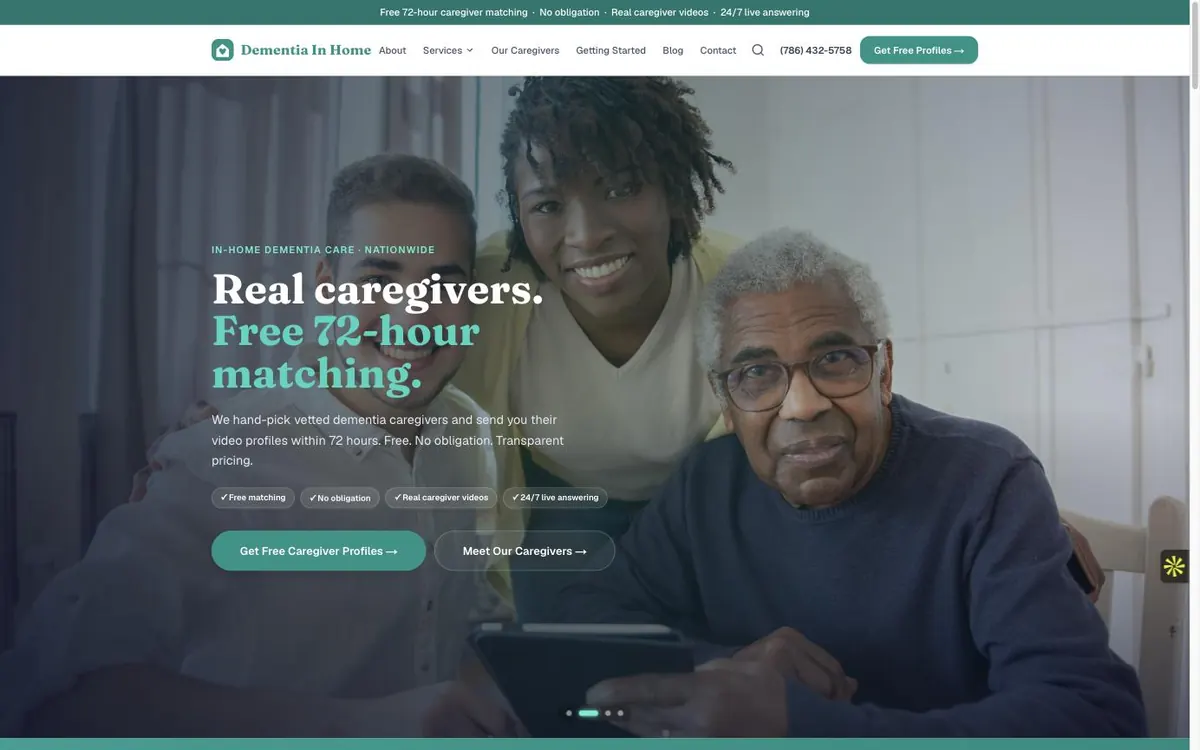
The matching offer itself is concrete and time bound. Free caregiver profiles within 72 hours, real video profiles rather than stock photography, and transparent pricing. Each of those is a claim the site then has to honour, which is what stops the copy drifting into the vague register that most care marketing occupies.
Everything above is verifiable on the live site.
- The sitemap carries 1,067 URLs: twenty cities with around fifty pages each, every one holding local pricing rather than a national figure.
- The homepage publishes a section explaining where its pricing numbers come from.
- Six distinct service paths are published, from companion care through to hospital discharge.
- Caregiver profiles are real video profiles, viewable before any commitment.
Nine tax calculators for a regulated UK practice
Read the case studyImpressifulA 1,000 product configurable catalogue in the UAE
Read the case studyMiyaki BeautyEcommerce for a premium beauty retailer in Accra
Read the case studyWorking on something with the same shape?