A 1,000 product configurable catalogue in the UAE
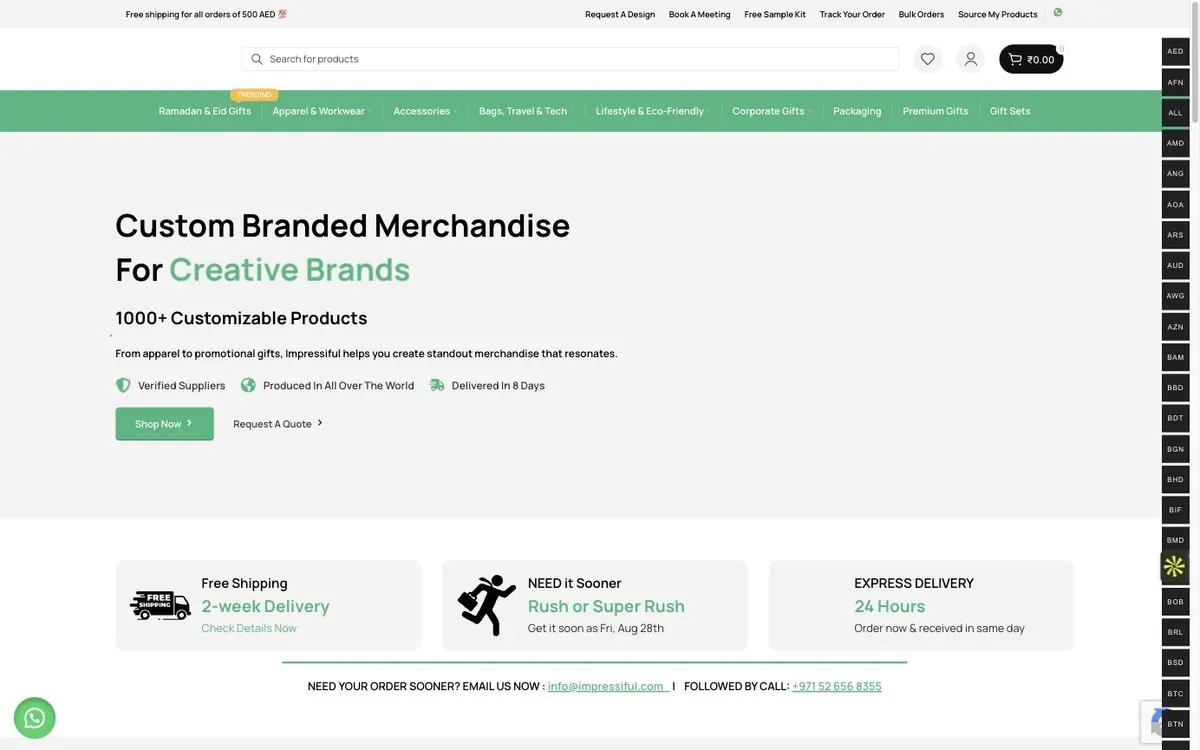
Impressiful sells custom branded merchandise to businesses in the United Arab Emirates. Every product is configurable, every order is a quantity negotiation, and the catalogue runs past a thousand items. None of that fits the shape of a normal ecommerce build.
- Client
- Impressiful
- Market
- United Arab Emirates
- Shipped
- 1,000+ products
Why a merchandise catalogue is not a shop
A standard store sells a fixed item at a fixed price. A branded merchandise business sells a blank product, a decoration method, a quantity band, and a logo the buyer has not sent yet. The price depends on all four, and the buyer usually wants to see a sample before committing to five hundred units.
Build that as a conventional product listing and you get a thousand pages that cannot quote, a cart nobody completes, and a sales team retyping the same questions into email all day.
Catalogue architecture
Over 1,000 configurable products sit across 21 categories: apparel from t-shirts and polos through jackets, vests, activewear and footwear, then bags and backpacks, drinkware, caps, corporate gifts, premium gifts, gift sets, boxes and packaging, office and stationery, home and living, travel and tech, eco-friendly ranges, uniforms and work apparel, accessories, and seasonal ranges including Ramadan and Eid gifting.
The category structure is doing real work. It matches how a corporate buyer actually shops, by occasion or by item type, rather than mirroring an internal product taxonomy. Seasonal categories such as Ramadan and Eid gifting matter commercially in this market in a way they would not elsewhere, and giving them their own path rather than a banner means they can rank and be found ahead of the season.
Two order paths, not one
The build separates the sample kit flow from the bulk order flow, because they are different purchases made by the same person weeks apart. A buyer evaluating quality wants one of each at any price. The same buyer approving a company-wide order wants a quantity quote and a lead time. Forcing both through one cart loses the first and frustrates the second.
Multi currency pricing supports a market where buyers and budgets are not uniformly denominated.
WhatsApp as commerce infrastructure
In the UAE, business buying happens on WhatsApp. Treating it as a support channel bolted to the side of a website misreads the market. It is wired into the checkout path, so a buyer with a question about a decoration method or a deadline can ask it at the moment of hesitation, in the channel they already use, without abandoning the configuration they have built.
This is the sort of decision that does not appear in a template and does not come from a best practice list. It comes from building for a specific market rather than a generic one.
Everything above is verifiable on the live site.
- Over 1,000 configurable products are listed, across 21 published categories.
- Category paths cover apparel, bags, drinkware, corporate and premium gifts, packaging, eco-friendly ranges, uniforms, and seasonal Ramadan and Eid gifting.
- A sample kit path and a bulk order path are separately available.
- WhatsApp contact is reachable from the product and checkout path, not only the footer.
- Website Development
- Ecommerce
- Technical SEO
Nine tax calculators for a regulated UK practice
Read the case studyDementia In HomeProgrammatic city pages for a US caregiver service
Read the case studyMiyaki BeautyEcommerce for a premium beauty retailer in Accra
Read the case studyWorking on something with the same shape?